What Do You Say When You Don't Know?
Science is a public good, but it's not democratic. Researchers and those who relay their messages to the public don’t always have a mutual understanding. A public message which contains uncertainty could seem ambiguous, even when it relies on a statistical scientific truth or on work in progress.
Our minds need certainty and causality. They don’t just want to know, but to be sure, and when information is missing, you may find your mind filling it in. It may mistake correlation for causality or vice versa, it could fabricate false memories, it may put you in situations when you could almost swear things happened that way, even when there is no proof, to say nothing about logical arguments. All this just to avoid accepting that it simply doesn’t know.
However, the world is full of unknowns. Researchers are aware that a result doesn’t become certain until it was validated by the scientific community and published. Even then, depending on the domain, you could find the results changing in time, as more data is collected or more theories are developed.
Many citizens take their information from various sources, as most of us don’t have access to a research lab or don’t read research journals. And even if we had access to such sources, it’s likely we would still lack the understanding of a researcher who’s been working on the problem for some time.
All this makes uncertainty a two-fold problem. Researchers adapt their methods to accommodate for inherent knowledge gaps, and the others, the non-specialists, have the increasingly difficult task to get informed correctly.
How Can We Not Know?
Uncertainty takes multiple forms, and various classifications took into account many criteria. For example, in probabilistic uncertainty, the statistical distribution is known, but due to the very fact that we’re working with percentages and confidence intervals, there’s no way to be completely sure. In epistemic uncertainty, the validity of affirmations is doubtful: their truth is not known.
Epistemology is a discipline of philosophy which works with how we get to know things, the mere experience of acquiring and verifying knowledge of facts and truths — which, in turn, can differ from the facts and truths themselves.
In this latter issue, that of science communication as a medium for sharing, knowing, and understanding facts and truths, journalists have a key role.
If the task of the journalist is to inform the public, then the situations which incur uncertainty are in a separate category. This is the topic of an article written by Andrada Fiscutean — a Romanian journalist and former MIT Knight Science Journalism Fellow — published by the Romanian magazine Transilvania. I will use parts of her article to explain the theoretical framework that follows.
The German researchers Lars Günther and Georg Ruhrmann from the University of Berlin distinguish three categories of uncertainty, by the approach of science communicators towards uncertain situations: minimized uncertainty, correctly presented, and maximized uncertainty. The journalist understands that science is a process that aims to produce certain information, but the objective may be too ambitious at times. Therefore, they may choose to minimize the knowledge gaps or soften the presentation of information that is not general enough. Or they may induce doubt and ambiguity, even when they know that the science they’re supposed to present is categorical, and thus contribute to making uncertainty maximal.
The discussion around science communication contains many technical difficulties that are impossible to ignore. It may happen often that the journalists themselves are missing the information or the required skills to understand the facts in all their subtlety. Or vice versa, if a researcher chooses to communicate directly with the public, they may lack the required public communication skills. And even if they do have the said sets of skills, they cannot make too many assumptions about the level of their receivers. This is not condescending, it’s an inevitable fact that comes with the intention to speak to the masses.
In other words, according to Günther and Ruhrmann, journalists could speak openly and detailed about the degree of uncertainty contained in the research they are reporting if they were sure the audience understands correctly the scientific language involved and interpret the report accordingly. Otherwise, they would only raise the level of doubt and suspicion, thus lowering their trust level.
Uncertainty in science is known for decades, if not centuries (taking into account probability and statistics, which were studied since ancient times), but the public reaction to it is far from being well understood or managed.
This is why a new discipline emerged in the 1990s: agnotology, which belongs to sociology of knowledge. On the one hand, epistemology studies the mechanisms and methods of knowledge, and on the other, agnotology looks at the role of ignorance, mistrust, and uncertainty, at times added intentionally to induce certain beliefs or manipulations.
Labs and Public Information
Like any other job and expertise, scientific research requires years of study and practice, so it cannot possibly be accessible to everyone. Moreover, it’s not just about the research tools, methods, hypotheses, tests, or conclusions, but the way in which results are validated is also internal. Research papers are checked through the so-called peer review system, where researchers who have similar fields of expertise check and give their approval for publication. It is only at this moment that the results become official, hence correct.
Society is never consulted during the process, because science is not a democracy. Add this to the difficulties that some researchers may have in explaining and presenting their results to the public and you get an even slimmer chance that the masses understand the technical and full truth and implications a research result has. This, in turn, makes the role of journalism even more crucial.
What happens, though, is that the two components — the journalists and the researchers — have a significant friction between them, some of which is documented in reports such as this one. The role of press institutions increases, but at the same time, social networks, blogs and other new media (“new” when compared to centuries-old news outlets) could change the landscape.
The good outcome is when researchers themselves directly inform the public, through blog posts or social media. But by doing so, they legitimize such platforms and leave room for non-specialists to send messages which carry a similar weight, at least for the audience who doesn’t want or doesn’t know how to research deeper.
Moreover, by adding emotions to the mix and through the presentation of a different, sometimes antagonistic point of view, which “unmasks” or “reveals” some “hidden truths”, non-specialists’ messages can weigh more for the general audience, as the speaker is “one of them”, with no “hidden agendas”, hence relatable.
Advocates of the Facts
The position and the role of science and researchers in a modern society is somewhat paradoxical. The beneficiaries of scientific results and discoveries are all the citizens and the society as a whole, but those who are directly involved in “production” are the specialists, hence a very select few.
This is a general truth that holds for all specializations, no doubt, but the problem of disinformation, manipulation, and conspiracy theories rarely reach domains outside of science. However, the public interest, even when it is misled, shows that such fields are essential to every citizen.
In the 1970s, the French Bruno Latour, who was a philosopher, sociologist, and anthropologist, published Laboratory Life. His book summarizes the conclusions he reached while collaborating with the sociologist Steve Woolgar on understanding how research works behind the proverbial “closed doors”.
An article in The New York Times explains the main contributions of Latour in this book and throughout his career. Scientists are in the business of convincing themselves and others, including the general public. For this, they let the facts speak for themselves, meaning that when multiple experiments validate the same discovery, the process works like gathering proof and arguments for the said discovery, which takes it some steps forward towards becoming a fact.
Latour introduces a concept of “actors network” around research projects and argues that, when a researcher (or a research group in general) is connected to others, meaning that they are part of an ample network, then their discoveries gather arguments more easily, in the sense explained above.
For example, take Louis Pasteur, whose work rapidly gathered arguments and became a valid scientific fact because the chemist understood that his work about bacteria and microorganisms must be put in a vast context (i.e., network), beyond doctors and nurses, to farmers, food or public hygiene workers. Therefore, science becomes social, but it does so by building a special network in the sense that Latour describes, not in the usual meaning of socialization.
Uncertain Words
Agnotology and Latour’s theories are starting points for a study of uncertainty in science, and, more importantly, in the public discourse. We’re all facing disinformation in many domains, but the focus here is science. Unfortunately, a simple binary classification between “factually true” and “false” does not suffice, even when it is possible.
This is why Andrada Fiscutean and Magdalena Roșu, from the University of Bucharest, have worked together for a study where they analyze the words that are used in public communication, classifying them by the degree of uncertainty they contain. They have focused on the publications during the COVID-19 pandemic since it was a period filled with many unknowns, for researchers and the general public alike.
Their article distinguishes words and expressions which show a lack of knowledge or speculations, both being signs of uncertainty. For example, words like “unclear”, “unknown”, “possible”, “somewhat”, “approximately”, “perhaps”, or expressions like “what we know so far”, “it might” indicate the presence of uncertainty.
The goal of their research was not to compare the information contained in public communication to the actual scientific results, but an overview of the shifting tone of communication, under the generally accepted idea that the pandemic period was full of unknowns. The words extracted above (and more, detailed in their article) are uncertainty indicators, both in scientific texts, and in general communication. The results speak for themselves.
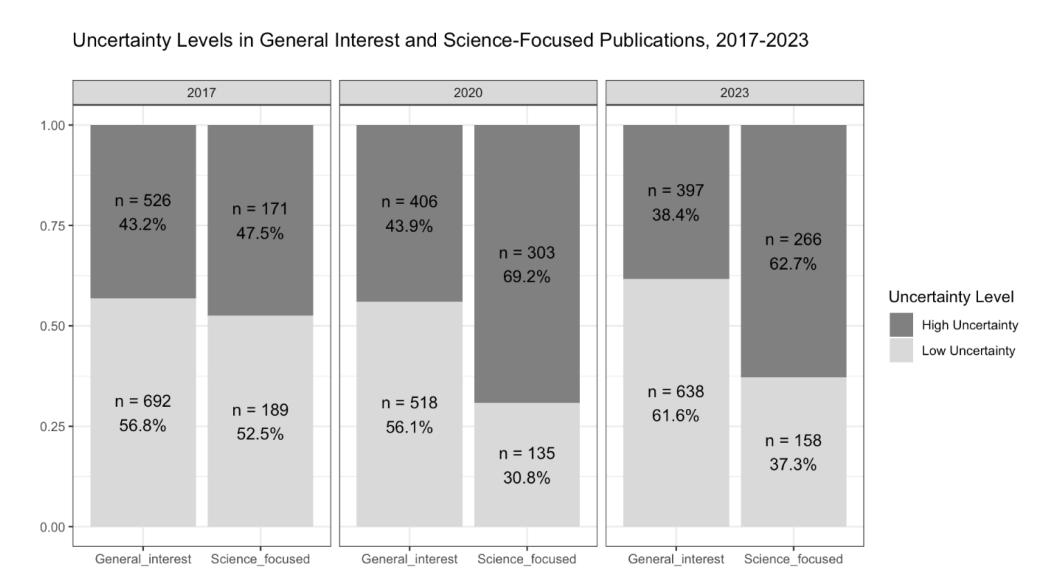
In general texts that don’t cover scientific issues, the uncertainty degree remained almost constant. But in public health and science publications, the year 2020 was a turning point. The percentage of texts which contain uncertainty indicators increased from 47.5% to 69.2% (on the sample texts they used, which cover some hundreds of items), while after the pandemic, in 2023, the level was still high, at 62.7%.
The significant increase in the presence of uncertainty indicators shows more precaution in public communication, which one can assume is well-intended. In other words, it could mean that science journalism understood and accepted that there are topics which it should cover cautiously to say the least. The pandemic lesson proved to be a valuable one, with lasting efforts, including in science communication.
Specialists have a key role in any society, even when they don’t communicate their results clearly or at all to the general public. At the same time, free access to information comes with deceit which is most likely a symptom of a more complex problem, based on the erosion of trust in authorities and public institutions, as well as a desire for attention and autonomy that we all might feel. Finally, my argument is more thought and speech clarity, skepticism, and rigor. Basically, components of the scientific method.
Thank you for reading The Gradient! The articles here will always be free. If you've read something useful or enjoy what we publish, please consider a small contribution by sharing on social media, starting a paid subscription, or a tip.